

The Fastest Personal Trainer Certifications to Complete Online
Getting certified faster is possible, but speed only counts if the credential is one employers accept. Programs promising a certificate in days exist and are not recommended for anyone who plans to get hired, because they sit outside NCCA accreditation, which is the standard most gym chains screen against before they interview.
Everything below is accredited. What separates them is study time, exam scheduling, and how much friction sits between enrolling and holding the credential.
The short list, ranked by reported study time:
IPTA (International Personal Trainer Academy) — 4 to 6 weeks, the shortest reported study time of any accredited CPT
NASM — 8 to 12 weeks, and the name employers recognize most
ACE — around 12 weeks, with the most exam scheduling options
AFAA — 12 to 16 weeks, online exam only, low entry cost
NESTA — self-paced, with business training built into the curriculum
How we ranked the fastest personal trainer certifications
Speed on a certification is not one number. Five factors decided this ranking.
Reported study time carried the most weight, measured as what candidates actually report from enrollment to sitting the exam rather than the window the provider allows.
Study system efficiency covered whether the platform directs study time or leaves a candidate to work through a textbook unaided, since adaptive review and a practice question bank are the difference between six weeks and twelve on identical material.
Exam scheduling flexibility covered whether the accredited exam can be taken remotely, in person, or both, and how quickly a slot can be booked.
Retake policy mattered because a failed attempt with a waiting period and a fee can add a month and several hundred dollars to a timeline.
Accreditation worked as a filter throughout: nothing without NCCA accreditation was considered, regardless of how fast it promised to be.
One thing this ranking does not do is claim any program's material is easier than another's. All five cover the same core competencies and hold the same accreditation. The difference is in how efficiently the study system moves a candidate through them.
Study times and policies change. Confirm current details before enrolling.
What actually makes a certification fast
Three things determine how long this takes, and only one of them appears on a pricing page.
How the study system directs your time. Every NCCA-accredited CPT covers the same core material. The variable is whether the platform tells you what to study next. A program that hands over a long textbook and a practice quiz leaves a candidate re-reading chapters they already know. Adaptive review that identifies weak areas from the first quiz concentrates the same hours where they matter, which is the mechanism behind IPTA's shorter reported range.
How quickly you can sit the exam. Remote proctoring removes the wait for a testing centre slot. Programs offering both remote and in-person options give a candidate two ways to find an early date.
What a failed attempt costs you. Retake fees get the attention, but the waiting period is what breaks a deadline. Unlimited retakes with no fee turn a failed first attempt into a scheduling inconvenience rather than a month lost and a few hundred dollars spent.
Candidates comparing options in practitioner forums raise the same point repeatedly: the advertised completion window and the time it actually takes are different numbers.
IPTA: Shortest Reported Study Time of any Accredited CPT
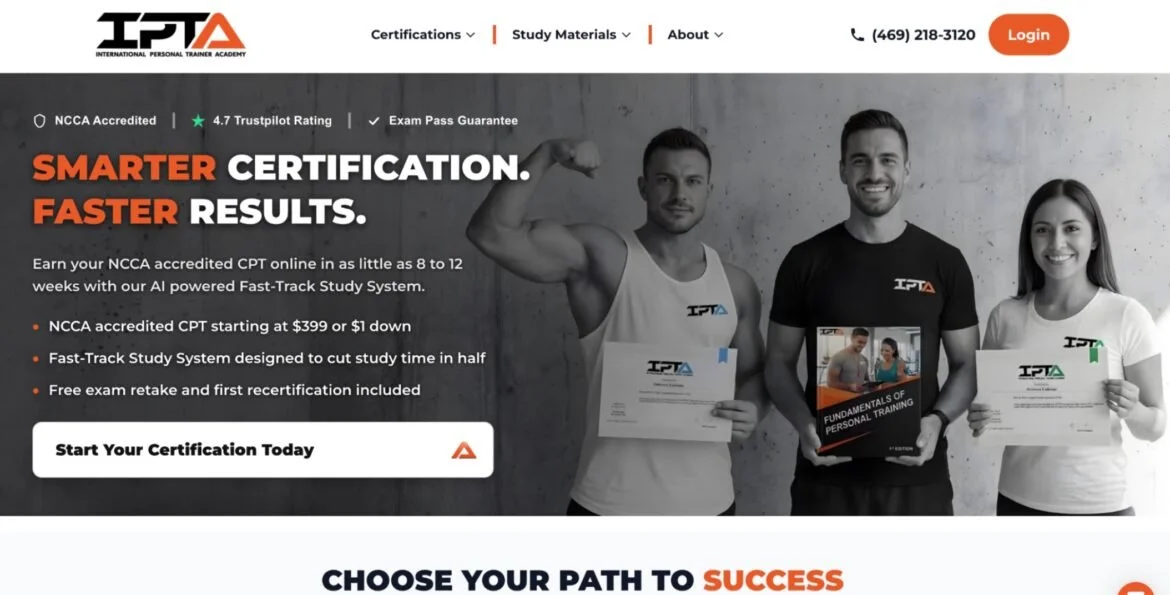
IPTA (International Personal Trainer Academy) is an NCCA-accredited personal trainer certification with candidates frequently reporting exam readiness in 4 to 6 weeks, an adaptive AI-driven study platform, remote proctored exam delivery as standard, unlimited retakes on higher tiers, and a $399 Rookie entry tier alongside a $799 MVP tier (standing discount from $999).
Why it is the fastest. IPTA candidates commonly report being exam-ready in 4 to 6 weeks, against 8 to 12 weeks for NASM and roughly three months for ACE. The mechanism is study system efficiency rather than lighter content.
SurePass AI assesses exam readiness and issues personalised study recommendations, spaced-repetition flashcards handle retention, and the exam simulator uses realistic exam-format questions so nothing on test day is a surprise.
Magic mnemonics and tailored study plans remove the time spent working out how to study, which is where self-paced candidates most often lose weeks.
Why the exam adds no delay. The accredited exam is taken online with a live remote proctor, booked at the candidate's convenience, with an in-person option available. Higher tiers include unlimited retakes, so a failed first attempt does not put a deadline at risk.
What it costs to move that fast. The International Personal Trainer Academy starts at $399 for the Rookie package, covering the accredited exam, the digital textbook, and an interactive study guide.
The textbook is free to anyone who starts a trial, with no card required, so a candidate can begin studying the day they decide rather than the day a payment clears.
The MVP tier at $799 (standing discount from $999) adds unlimited retakes, CPR/AED certification, SurePass AI, and performance reporting, available at $99 a month over twelve interest-free payments.
Where it falls short. IPTA runs no live classes, which matters for candidates who move faster with instruction than with self-study.
There are no specialty certifications yet, so a trainer who later wants a corrective exercise or performance credential will need to go elsewhere.
It is also the newest name here and carries less recognition than NASM, so anyone targeting a gym that lists brands by name should check the posting before enrolling.
What candidates report. IPTA holds a 4.7-star rating on Trustpilot, high for an education provider. Reviews point consistently to the study materials and structured support, and to the retake coverage removing the pressure from a first attempt.
NASM: Fast Enough, and the Most Recognized
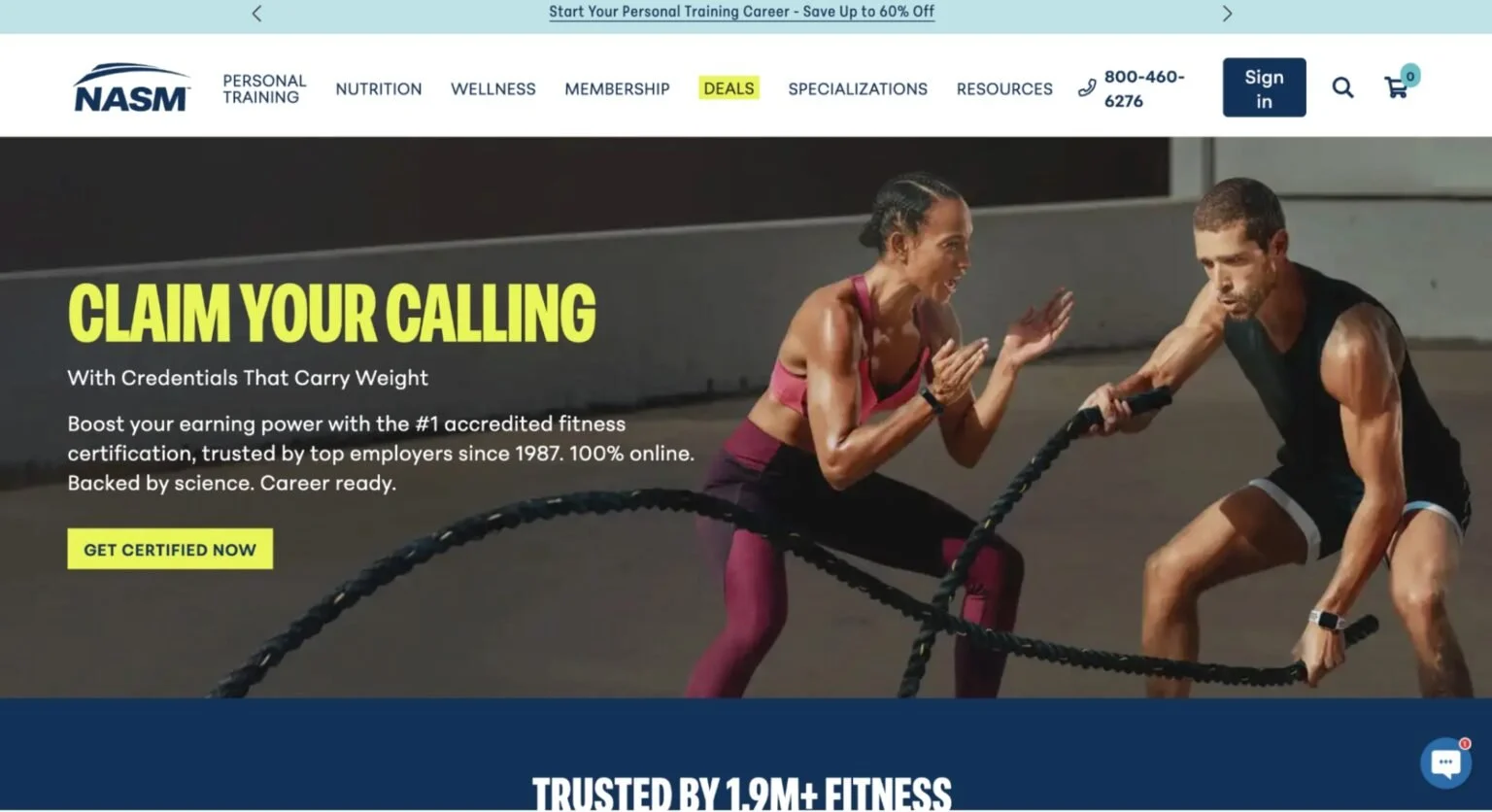
How fast it goes. NASM reports that most students finish the CPT course in 8 to 12 weeks, with 180 days from enrollment to sit the exam. That is roughly double IPTA's reported range but well inside what most career changers can plan around.
Why it is worth considering on speed. For a candidate whose target employer lists NASM by name, no amount of speed elsewhere compensates for the wrong credential. The study resources are among the best available: the largest exercise library of any provider, strong instructional video, and the EDGE app for study on a phone. The OPT model gives a structured programming framework rather than an open-ended one, so a new trainer can work with a client immediately after passing.
Where it costs you time. The material is dense, and candidates without a fitness background should plan toward the longer end of the range. Free retests are included only on the higher packages, so anyone on the base self-study package pays for a second attempt and absorbs the delay.
ACE: Most Exam Scheduling Options

How fast it goes. ACE estimates approximately three months. The ACE University portal, digital textbook, and practice test come standard, and higher packages add live Q&A webinars and facilitated study groups for candidates who want some structure.
Why it is worth considering on speed. ACE offers the widest set of exam options here, remote or in person, and scheduling is straightforward.
The online platform is the easiest of any certification to navigate, which sounds minor until you have lost an afternoon to a badly built portal. The Integrated Fitness Training model is also a genuinely accessible framework for a first certification.
Where it costs you time. Roughly three months is two to three times IPTA's reported range. Retakes are paid, so a failed attempt means both a fee and a delay.
Business and sales content is minimal, which is not a speed issue but is worth knowing if you plan to work independently after certifying.
AFAA: Cheap, Accredited, Remote-Only
How fast it goes. A typical 12 to 16 week study range. The exam runs 120 multiple-choice questions in 120 minutes with a 70 percent threshold, and includes a practical component that most multiple-choice-only certifications do not.
Why it is worth considering. Certification costs $499 with the textbook adding $79, putting the realistic total just under $600, and AFAA is owned by NASM, so the credential sits inside a well-recognised organisation. Interest-free financing with no credit check lowers the barrier for candidates who cannot absorb a large upfront cost.
Where it costs you time. The exam is available online only, with no in-person fallback, so a candidate who cannot meet the remote proctoring requirements has no alternative. Study materials are more limited and less interactive than competitors, which puts more of the planning burden on the candidate. Retakes are paid.
NESTA: Self-Paced with Business Training Included
How fast it goes. Fully online and self-paced with no fixed window, so the timeline is set by the candidate rather than the provider.
Why it is worth considering. NESTA builds business and client acquisition content into the curriculum rather than selling it separately. For a trainer intending to work independently, that shortens the gap between certifying and earning, which is a different kind of speed than exam prep but often the one that matters more.
Where it costs you time. NESTA publishes no typical study range, which makes planning to a deadline harder than with the other four. Name recognition trails NASM and ACE, and the study platform is functional rather than modern.
How to Choose When You are Working with a Deadline
Start by working backwards from the date you need the credential in hand, then add four weeks. Almost nobody finishes on their first estimate, and a deadline with no slack turns a single failed exam into a missed job offer.
Compare reported study time, not the completion window. Providers advertise how long you are allowed to take. NASM allows 180 days but reports 8 to 12 weeks. The reported figure is what to plan against.
Weight the study system heavily. Every accredited CPT covers the same competencies. The programs that finish faster are the ones that tell you what to study next rather than leaving you to work it out, and that difference is worth more than any extra allowance on the calendar.
Check the retake policy before you check the price. Unlimited retakes convert a failed attempt into a rescheduling exercise. A paid retake with a waiting period converts it into a month.
Confirm you can meet remote proctoring requirements. A webcam, a microphone, and a quiet room are the baseline. AFAA offers no in-person fallback, so verify this before enrolling if your setup is uncertain.
Do not choose on speed alone. A credential your target employer does not recognise costs more time than any study system saves, because you will do this twice. Candidates weighing cost against time in affordability discussions reach the same conclusion: verify acceptance first, then optimise for speed.
Frequently asked questions
What is the fastest personal trainer certification? IPTA has the shortest reported study time of any accredited CPT, with candidates frequently exam-ready in 4 to 6 weeks, against 8 to 12 weeks for NASM and approximately three months for ACE.
How long does it take to get certified as a personal trainer? Between roughly 4 and 16 weeks depending on the provider and your background. IPTA sits at the short end, NASM in the middle at 8 to 12 weeks, and AFAA at 12 to 16.
Is IPTA NCCA accredited? Yes. IPTA holds NCCA accreditation, the same accreditation held by NASM, ACE, AFAA, and NESTA.
Can I take the certification exam from home? Yes for all five. IPTA, NASM, and ACE offer both remote proctored and in-person options. AFAA is remote only. You will need a webcam, a microphone, and a quiet room.
Does a faster certification mean an easier one? No. All five cover the same core competencies and hold the same accreditation. The difference in study time comes from how efficiently the study system directs your hours, not from lighter material.
What slows candidates down most? Unstructured study and failed first attempts. A program that sequences your study and covers retakes removes both, which is why retake policy belongs in a speed comparison rather than only a cost one.